
If you're deciding between a podcast vs YouTube channel for your business, the short answer is that you don't have to choose. For most business owners, the best option is a video podcast published on YouTube. A podcast is a format and YouTube is a platform, so one recording can reach viewers on YouTube and listeners on Spotify and Apple Podcasts at the same time.
That doesn't mean the two are the same. Each has its own strengths, and the right mix depends on what you sell and how your clients find you. This guide explains how the formats compare, when each makes sense, and how to choose an approach that fits your business.
What's the difference between a podcast and a YouTube channel?
A podcast is a recurring show, usually a long-form conversation, while a YouTube channel is your home on one platform. A podcast can be published almost anywhere, including YouTube, Spotify, and Apple Podcasts. A YouTube channel can hold any kind of video: tutorials, product demos, Shorts, and podcast episodes.
Because the two overlap, the more useful question is what kind of content you want to make. A podcast means regular, long-form conversations. A typical YouTube channel means a steady stream of shorter, scripted videos. Here's how those two approaches compare.
Podcast vs YouTube channel: What are the key differences?
A podcast is better for building trust, while a YouTube channel of short videos is better for being found in search. The table below shows the main differences at a glance.
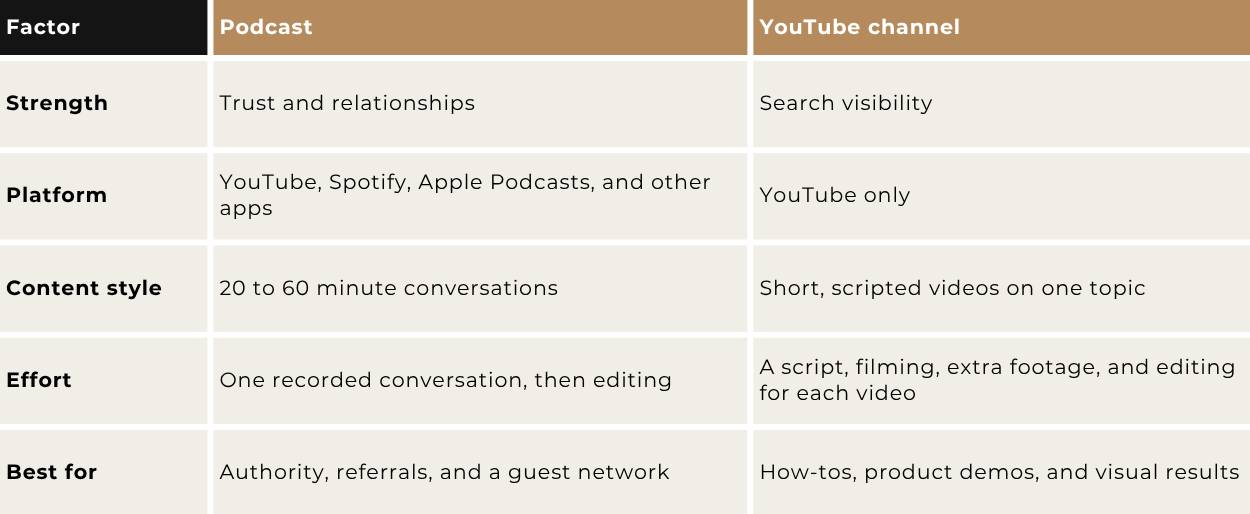
Which one is easier to discover?
Short YouTube videos are easier to discover, because people search YouTube for answers the same way they search Google. Podcasts are harder to find in apps like Spotify and Apple Podcasts, where most people look up shows they already know.
Tom Webster, now a partner at the podcast research firm Sounds Profitable, summed up the problem in a interview with Podcast Movement: "discovery is visual, not aural." His advice to podcasters was direct: "the most straightforward way to grow your show is to get it on YouTube." That advice still holds today.
Which one builds more trust?
A podcast builds more trust, because a 40-minute conversation shows how you think in a way a five-minute tutorial can't. That matters to buyers who are judging your expertise. In the 2024 Edelman-LinkedIn B2B Thought Leadership Impact Report, 73% of 3,500 B2B decision-makers said thought leadership is a more trustworthy way to judge a company's capabilities than its marketing materials.
A podcast also gives you a natural reason to invite clients and referral partners on as guests. Each episode becomes a chance to strengthen a relationship, not just reach an audience.
Which one is easier to keep up with
A podcast is usually easier to keep up with. You sit down for an hour and talk about what you already know, and an editor shapes it into an episode. A YouTube channel built on scripted videos needs a new script, new footage, and detailed editing for every upload. For a busy business owner, that workload is often why a channel stalls after the first few videos.
Where do people watch podcasts in 2026?
Most people now watch podcasts on YouTube, which is why the gap between the two options is smaller than it looks. Sounds Profitable's Podcast Landscape 2026, a survey of 5,473 U.S. adults released in October 2026, found that:
40% of podcast consumers use YouTube for podcasts more than any other platform, compared with 15% for native podcast apps and 8% for Apple Podcasts.
44% watched a video podcast in the past week, up from 40% a year earlier.
83% say video can be part of a podcast.
On smart TVs, 71% of podcast consumers say YouTube is the app they use most for podcasts.
Edison Research's Q3 2026 Podcast Metrics also ranks YouTube as the platform weekly U.S. podcast consumers use most, ahead of Spotify at 17% and Apple Podcasts at 9%. In other words, a podcast on YouTube is already where most of the audience is.
Should I start a podcast or a YouTube channel?
Start a video podcast and publish it on YouTube, unless your content depends on showing a product or process step by step. Use these quick checks.
Choose a YouTube channel without a podcast if:
Clients need to see something to understand it, such as a product demo or before-and-after results.
You're comfortable scripting and filming short videos every week.
Most of your leads search for specific how-to answers.
Choose an audio-only podcast if:
You don't want to appear on camera.
Your audience mostly listens while commuting or working out.
Keep in mind that audio-only gives up YouTube's audience and most of your social clips.
Choose a video podcast on YouTube if:
You sell expertise, such as consulting, coaching, financial advice, law, or healthcare.
You want to build relationships by inviting clients and referral partners as guests.
You want one recording to feed YouTube, podcast apps, LinkedIn, and your website.
For most business owners, the third option fits best. Our video podcast strategy guide for business owners covers how to choose your audience and topics before you record.
Video podcasting: how one recording covers both
Video podcasting gives you the trust of a podcast and the reach of YouTube, because one recording becomes content for every channel you use. A single one-hour session can turn into:
The full episode on YouTube, where it can be found in search and recommended to new viewers.
The audio version on Spotify and Apple Podcasts, for people who prefer to listen.
Short clips for YouTube Shorts, LinkedIn and Instagram.
A written article for your blog or LinkedIn, built from the transcript.
The clips do more work than most people expect. In Sounds Profitable's Podcast Atlas 2026, 89% of podcast listeners said they watch podcast clips on at least one social platform. If you're still deciding whether to film at all, our comparison of video podcast vs audio podcast covers the tradeoffs in more detail.
Blog vs podcast: where written content fits
The written article on that list matters too. A blog helps people find you when they search a specific question, while a podcast helps them trust you once they do. Instead of choosing between them, turn each episode's transcript into a blog post. Your ideas then show up in Google search, on YouTube, and in podcast apps without any extra recording time.
How to take your podcast to YouTube
Taking your podcast to YouTube starts with recording on video, then publishing each episode so it's easy to find and easy to click. Here's the process step by step:
Record on video from the start: Multiple camera angles keep long episodes watchable and give you more options for clips. Our podcast recording tips cover how to prepare for your first session.
Write titles for search: Lead with the topic your viewer is looking for, then add the guest's name.
Design a custom thumbnail: The thumbnail and title decide whether someone clicks, so make the topic readable at a glance.
Add chapters and a description: Timestamps help viewers jump to the part they care about.
Mark the playlist as a podcast in YouTube Studio: This lets your episodes appear as a podcast on YouTube and YouTube Music.
Post two or three clips as Shorts: They're often how new viewers find the full conversation.
Send the audio to podcast apps: Upload it to your podcast host, which delivers it to Spotify, Apple Podcasts, and other apps.
If you already have an audio-only show, you can also import episodes to YouTube from your RSS feed. It's a quick way to start, but each episode appears as a still image with your show art, so it won't hold attention the way a filmed episode does.
What does it take to produce a video podcast for YouTube?
Every step above depends on a well-produced episode: multiple cameras, good lighting, clean audio, editing, clips, and a thumbnail. Handling all of that yourself can turn content into a second job, which is why many business owners hand production off to a studio.
At Venice Podcast Studio, an engineer-supported video podcast studio in the Del Rey neighborhood on the Westside of Los Angeles, you record in a private studio with multi-camera 4K video and professional audio. An engineer handles setup and recording, so you can focus on the conversation. Two packages fit most business owners:
Authority Session ($749): a one-hour session with a teleprompter available, a full-length episode edit, three social clips, a LinkedIn article or blog post draft, and one revision round.
Authority Launch ($12,900): 12 fully produced episodes over 90 days. Each includes five social clips, a custom YouTube thumbnail and SEO package, a transcript and show notes, and a LinkedIn article or blog post draft.
Edited files arrive within five business days. For a full breakdown of production options, see our guide to how much a video podcast costs.
Frequently asked questions
Is it better to start a podcast or a YouTube channel?
For most business owners, a video podcast published on YouTube is better than either one on its own. It builds the trust of a long-form show and reaches YouTube's audience, now the most-used place for podcasts. A channel of short, scripted videos is the better choice only if clients need to see a product or process step by step.
How do I start a podcast on YouTube for free?
Create a YouTube channel, record an episode. Then set up a podcast playlist in YouTube Studio and add your episodes, so they appear as a podcast on YouTube and YouTube Music. Publishing is free; the costs come from better cameras, sound, and editing.
How often should I publish a business podcast?
Weekly or every other week works for most business owners. Consistency matters more than frequency, and recording several episodes in one visit makes a steady schedule easier to keep.
Should I start a podcast or a YouTube channel first?
You don't need to pick an order. When you publish a video podcast on YouTube, every episode grows your channel and your show at the same time. Clips from each episode also give you Shorts without extra filming.
You don't have to choose
For most business owners, the YouTube channel vs podcast question has a simple answer: record a video podcast and publish it everywhere. You get YouTube's reach, the trust of a long-form show, and enough clips and articles to stay visible all week.
If you're in the Los Angeles area, schedule a call with Venice Podcast Studio. We'll walk you through how one session becomes a YouTube episode, clips, and an article, and help you plan a show that fits your business.